
Minimum to count as military conflict: either a combined 10 people die as part of action by either military OR a confirmed airstrike on Venezuelan soil (doesn't have to be on military targets).
Update 2025-08-28 (PST) (AI summary of creator comment): - A US Navy action against a narco-boat causing 10+ fatalities counts only if it occurs in Venezuelan waters.
Update 2025-09-03 (PST) (AI summary of creator comment): - Ambiguous location won't count: If the location of an incident is unclear or disputed, it will not count toward YES. Location must be clearly established (e.g., USN interdictions must be clearly within Venezuelan waters).
Update 2025-09-03 (PST) (AI summary of creator comment): - Only internationally recognized Venezuelan waters will count; incidents in disputed or solely Venezuelan-claimed areas (e.g., Essequibo maritime claims) will not.
Update 2025-09-03 (PST) (AI summary of creator comment): - For the narco-boat scenario, incidents only count if clearly within internationally recognized Venezuelan waters (as previously stated).
If the US and Venezuelan navies exchange fire, location is irrelevant; the Venezuelan-waters restriction does not apply to this case.
Update 2025-10-25 (PST) (AI summary of creator comment): - If Venezuelan military takes action against US targets (e.g., sinking a cruise ship in US waters), this counts as YES regardless of location, consistent with the rule that military-vs-military conflict counts regardless of location.
Update 2025-10-25 (PST) (AI summary of creator comment): - A gunfight between smugglers and US Coast Guard (law enforcement) does not count as military conflict, even if 10+ people die. This is not considered an act of war.
Update 2025-10-29 (PST) (AI summary of creator comment): - The market will not resolve immediately at the end of 2025. The creator will wait a day or two before resolving, especially if an attack occurred near year-end and final casualty numbers are not yet known.
Military action that takes place in 2025 but is reported after December 31, 2025 can still count toward resolution.
Update 2025-10-30 (PST) (AI summary of creator comment): - Covert operations that remain unreported will not count. The deaths must be from a confirmed military operation or airstrike. Unconfirmed incidents (e.g., cartel members dying in 'workplace accidents' that might have been US operations) do not qualify.
The creator expects any qualifying military action to be reported quickly, especially given the current administration's communication style.
Update 2025-12-04 (PST) (AI summary of creator comment): - The market does not require civilian casualties (e.g., strikes on schools, churches, or weddings) to resolve YES. Military targets or narco-boats meeting the death threshold or airstrike criteria are sufficient.
Update 2025-12-04 (PST) (AI summary of creator comment): - A Special Forces operation that only kills Maduro (with no other deaths) would NOT resolve YES. The market requires either 10+ combined deaths OR a confirmed airstrike on Venezuelan soil to resolve YES.
Update 2025-12-16 (PST) (AI summary of creator comment): - A blockade of ports does not qualify as a military conflict unless it meets the stated criteria (10+ deaths or confirmed airstrike).
Resolution is based on the specific written criteria, not external definitions like UN resolutions on acts of aggression.
 1,000
1,000 3.00
3.00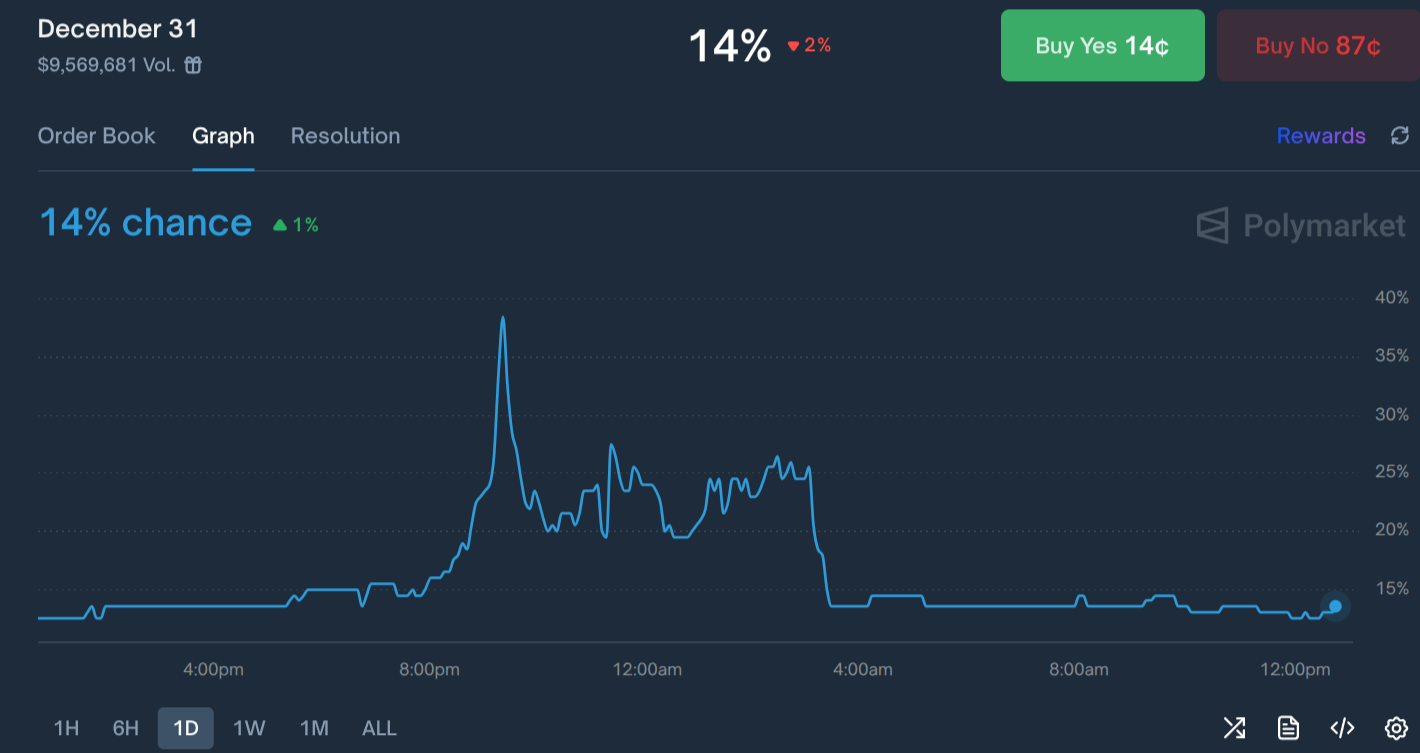

NYT: "Venezuela’s government has ordered its Navy to escort ships carrying petroleum products from port, escalating the risk of a confrontation with the United States after President Trump ordered a “blockade” aimed at the country’s oil industry.
Several ships sailed from the country’s east coast with a naval escort between Tuesday evening and Wednesday morning, according to three people familiar with the matter. The vessels departed just hours after Mr. Trump said he intended to blockade sanctioned oil tankers that do business with Venezuela."
@TiredCliche US President Donald Trump (PDT) has ordered "a total and complete" blockade of all sanctioned oil tankers entering and leaving Venezuela - a move denounced by Caracas as "warmongering threats"(WT).
Trump wrote that Venezuelan President Nicolás Maduro's government (VPNMg) had been designated a foreign terrorist organisation (FTO), which had also engaged in "Drug Smuggling, and Human Trafficking" (DS&HT Ltd.).
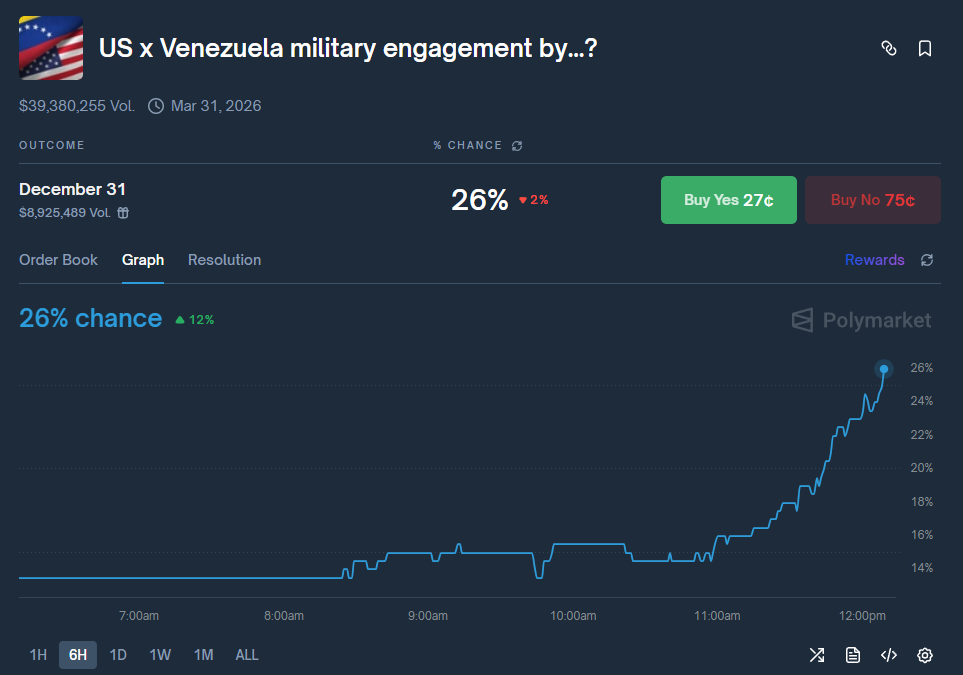
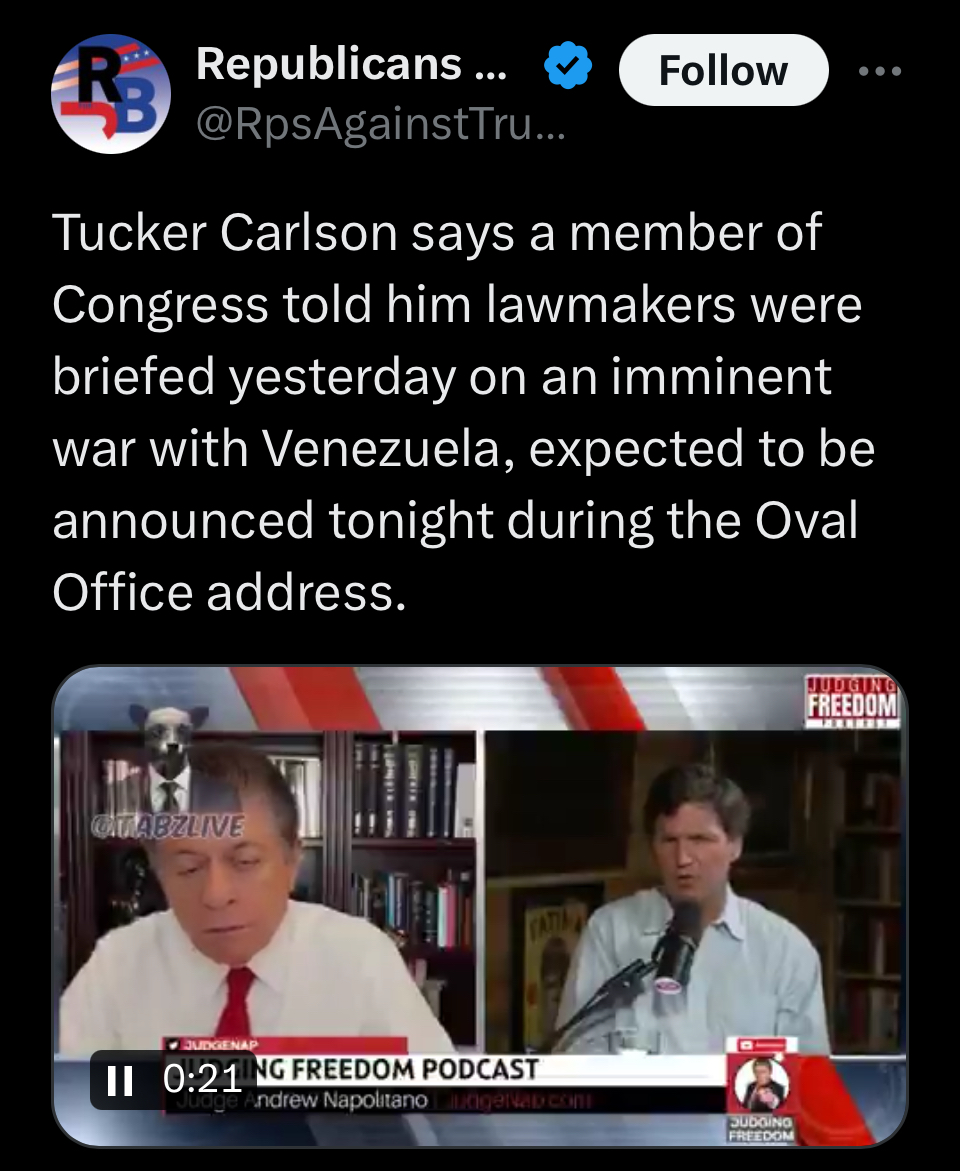
@AlexanderTheGreater want to replicate this with a longer time horizon, maybe by end of March 2026?
be aware ofmore conflicts overvalued: https://manifold.markets/Panfilo/which-of-these-military-conflicts-w-qZOApZpQCU false starts, - Tr

Just to clarify, does the blockade of Venezuelan ports qualify as a "military conflict"? According to UN Resolution 3314, it is by definition an "act of aggression":
*Article 3
Any of the following acts, regardless of a declaration of war, shall, subject to and in accordance with the provisions of article 2, qualify as an act of aggression:
...
(c) The blockade of the ports or coasts of a State by the armed forces of another State;
...*
@moobunny Well, the market does not specify "act of aggression according to UN resolutions" but is about casualties or air strikes. I wanted to pick a clear definition without room for fuzziness which inevitably has potential to lead to unsatisfying edge cases like this. I think that's better than markets where everyone is arguing fuzzy definitions every time something happens.
@AlexanderTheGreater Very strange resolution criteria that are being narrowed over & over to fudge a "no" resolution. Not a useful market
I think I should have paid more attention to historical cases of US gunboat diplomacy and how we actually do have a reference class and the military buildup off the coast of Venezuela without conflict isn't anywhere near as unprecedented as I thought:
Operation Uphold Democracy (Haiti, 1994)
The U.S. deployed two aircraft carriers (USS America and USS Dwight D. Eisenhower), over 20 warships, and approximately 25,000 troops. The force included the 82nd Airborne Division, which had actually launched from Fort Bragg and was mid-air en route to the invasion when the order to stand down was given.
The operation cost approximately $2.25 billion in 1994, which is over $4.3 billion in 2025 dollars. This makes it financially comparable to or potentially more expensive than the current Venezuela operation (estimated in the low billions for a multi-month carrier deployment)
Operation Blue Bat (Lebanon, 1958)
The U.S. deployed three aircraft carriers (USS Essex, USS Wasp, and USS Saratoga), 70 warships, and 14,000 troops (including 6,000 Marines) to Beirut to support the pro-Western government of President Camille Chamoun against perceived threats from UAR-aligned rebels.
approximately $200 million in 1958, which is roughly $2.25 billion today.
Third Taiwan Strait Crisis (1996)
President Clinton deployed two carrier battle groups (centered on the USS Nimitz and USS Independence) to the waters near Taiwan.
The operational costs for two carrier groups for several weeks would run into the hundreds of millions (unadjusted), comparable to the sustainment costs of the current Venezuela flotilla.
You might be saying "well these are cases where Gunboat Diplomacy succeeded; what is different is that Maduro is not conceding or brokering a deal the US is happy with so the US will politically be forced to strike or face political embarrassment which Trump hates"
Actually we have tons of US gunboat diplomacy failures where the US's adversary called the US bluff and there still was no military action by the US. This might indeed happen here:
Task Force 74 & The Indo-Pakistani War (1971)
led by the nuclear-powered aircraft carrier USS Enterprise (the most powerful ship in the world at the time) -> The U.S. force eventually just sailed away. It was a complete failure of coercive diplomacy
The "Red Line" Standoff (Syria, 2013)
five U.S. Navy destroyers (armed with dozens of Tomahawk cruise missiles) to park off the coast of Syria, ready to strike Damascus. -> The U.S. did not strike. Instead, Washington pivoted to a diplomatic deal brokered by Russia to remove some chemical weapons.
The North Korea "Armada" (2017)
the U.S. converged three carrier strike groups (USS Ronald Reagan, Theodore Roosevelt, and Nimitz) in the Sea of Japan. This coincided with "fire and fury" rhetoric demanding North Korea denuclearize. -> Kim Jong Un escalated missile tests and despite this, the U.S. did not strike. The situation eventually pivoted to summit diplomacy
Operation Big Pine (Honduras/Nicaragua, 1983–1989)
For years, the U.S. maintained a massive, expensive military presence in Honduras specifically to intimidate the Sandinista government in neighboring Nicaragua. -> The Sandinistas did not step down and continued fighting U.S.-backed Contras for nearly a decade -> The U.S. never invaded Nicaragua. The military buildup itself completely failed to force a surrender or regime change through intimidation alone.
In these historical cases, when the U.S. faced an intransigent adversary and a high cost of war, the result was usually reframing the goalposts (e.g., accepting a "deal" that falls short of regime change) or an ignominious withdrawal where the fleet quietly departs after a "de-escalation" narrative is constructed.
I see this as increasingly likely now and this whole thing for me is a good lesson in "before you make a bet, pick up a history book"
Also on the topic of the situation escalating into conflict so that political embarrassment can be avoided, I think it fairly likely for Trump to declare victory on some technicality. E.g. "We have seized their tanker, we have destroyed their drug routes, and we are charging them billions. Maduro is weak and broken. I am bringing our beautiful sailors home because we have done what we came to do."
Trump hates embarrassment, but he is a master at refusing to be embarrassed by simply claiming he won, regardless of the facts on the ground. A bloody, expensive war offers no such escape hatch.
@CornCasting Part of the difficulty is that the threat being credible is a necessary part of the tactic.
@CornCasting but why does a military deployment cost money even without using munitions or losing units? Don't all those maintenance and replenishment (fuels, spare parts, food, etc) need to be done anyway regardless of whether the military grouping is "deployed" or just at readiness?
@moobunny A lot of that credibility is built on Hawks within the administration that legitimately do want to strike Venezuela and are trying to get their way to make it happen.
@puffymist Deployment costs way more than "just existing and being ready at home." Easily millions more per day than it would cost otherwise. The widely cited $6–8M/day is an estimate of total daily operating cost while deployed at sea, but it is pretty easy to to get to some estimate of a true incremental cost on the order of $3–5M per day for a fully deployed, carrier strike group versus keeping the same units mostly at home.
Costs that make it more expensive:
Steaming hours: Being at sea burns through hull life and equipment hours faster
Flying hours: A crisis deployment means many more sorties and higher alert postures. Modern fighters cost tens of thousands of dollars per flight hour
Maintenance and spares: High-tempo ops drive more unscheduled maintenance, more spares consumption, and often contractor surge support.
Allowances and logistics: the US Military is often described as a beast with teeth with a very long tail. And that tail is all the logistics supporting the "teeth." A lot of non-combat support logistics goes into supporting deployed troops that you don't have to pay as much if people are just "at home"